
Issue 03 · July 28, 2026
A performance review shouldn't be an annual event
Chris Gerlach · Co-Founder & CEO, Comp · ~7 min read
Original thinking on AI-Native HR, for the CHROs and CEOs deciding what AI does inside their company.
Editorial
The traditional performance review rests on a shaky foundation. It runs on a manager's memory of someone's year, written down the week the form is due, and treats that memory as the official record, even though it is one of the least reliable inputs a company has.
I'd go further. The annual review survives because, until very recently, the two things it assumes were basically true, that a manager's memory was the best available evidence of how someone worked and that performance could only be judged at scale on a calendar. AI breaks both at once, and so performance management should stop being an event and become part of the work itself.
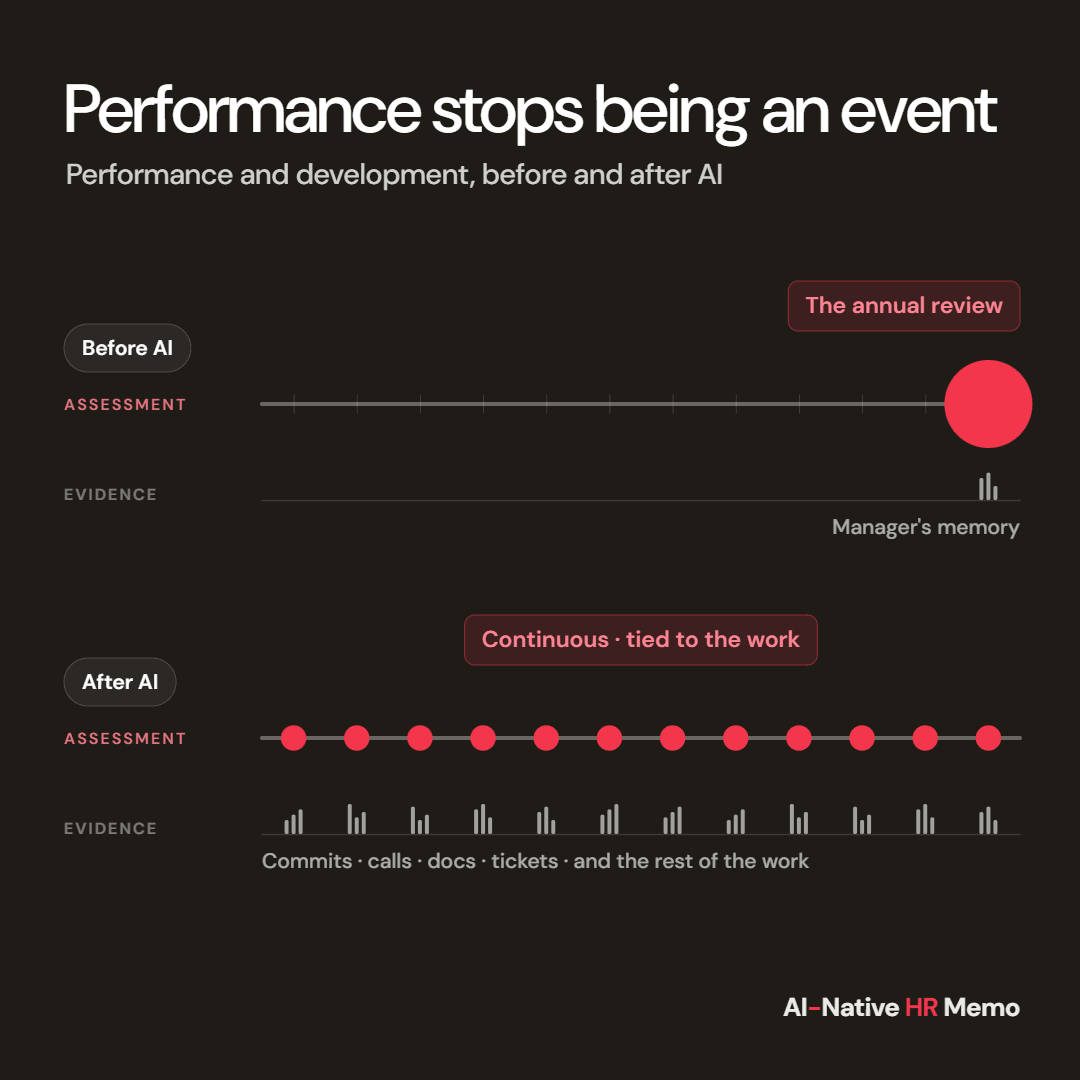
Start with the evidence. The vast majority of what an organization produces is unstructured, and that is often where the truth about performance lives. The commits and code reviews, the call recordings, the documents shipped, the tickets closed, the Slack thread where someone quietly unblocked a teammate, etc. The old review ignored all of it and ran on a manager’s rough summary. When a model reads the work directly, the evidence shifts from what a manager remembers to what the person actually produced.
Then, once the evidence changes, the calendar follows. Reviews attach to real milestones (a launch, a quarter of quota, a project delivered) and feedback arrives while it can still change the outcome. The dreaded once-a-year conversation quite often turns into a summary of feedback that already happened. And promotion-readiness can be checked whenever it matters, instead of argued once a year by whoever speaks most convincingly in the room.
Also, there is a quieter win that I think matters most, and it is fairness. A single manager’s rating carries that manager’s blind spots and recency bias. Reading and reconciling many independent signals is the most reliable way we know to correct for that. A wider base of evidence is simply a fairer one.
We have been running performance this way at Comp for a while.
There is one risk I would not publish this without naming. Reading someone’s work continuously, artifact by artifact, can easily slide into surveillance. What keeps it on the right side is what the system is allowed to read, what it is told to ignore, and whether the employee sees the same view their manager does. Get that wrong and the fairness gain becomes a collapse of trust (worse than the annual review you were trying to replace).
To be clear: none of this removes the human in performance review. Someone still decides! When a manager edits the summary the system drafted, that edit should feed back as a signal that teaches the system what good work looks like in that company. And this makes next year’s review better than this one’s. And when it works, managers stop rebuilding the case from memory and spend that time with the person instead.
Next in this series, the same lens on another HR subfunction.
Once again, let us know what you thought of this piece. The newsletter compounds when you do.
Hope you enjoy what follows,
Chris Gerlach · Co-Founder & CEO, Comp
Spotlight
Gustavo Victorica · Co-founder & COO, RecargaPay
Fintech · Payments · 500+ FTEs · São Paulo
At RecargaPay, HR is “people operations” and reports to Gustavo, the COO. As AI takes over execution, what he started asking of the team is the discernment to know what the business needs.
“In the end it's about ownership, but ownership of the outcome. Execution with AI has become trivial. You can prompt something and a product will come out. But what you put into that prompt, how you iterate, what you distill from your knowledge, what the actual need of the business was, that's the hit or miss.”
Gustavo Victorica · Co-founder & COO, RecargaPay
As execution gets cheap, the bar for a team becomes the judgment about what to ask for and what the business actually needs.
Reads
Worth reading before the next issue
Substack · Essay · Jul 21
Against Claudefishing
Substack is going to start flagging “likely AI text”, and Dan Hockenmaier (CSO at Faire) predicts that within 12 months most companies will have formal “anti-slop” policies. We believe the written rule weighs less than a culture of ownership, where whoever produces owns the result, with AI helping with first drafts and the person owning the final version. It is the same human judgment that sits at the center of the editorial.
Mercer · Report
The Early Career Paradox
AI-Native companies have a more senior org chart, with more engineering (50.7% versus 38.2%) and a thinner junior base, according to Pave's CEO. For Mercer, as AI absorbs the entry-level task, the junior takes on high-stakes work early and with fewer people to teach them, and only 34% feel encouraged to learn on the clock. That base was always where a company grew its future leaders; so, for anyone building AI-native HR, the open question is how to grow those future leaders in this scenario.
Demo
When context becomes efficiency in HR
 Watch · video
In the video, Pedro Bobrow (Co-founder & CHRO at Comp) resolves a vacation request and a health-plan dependent addition on the spot: the AI cross-checks balance, policy, deadline, and document, proposes the way out, and takes it to the manager to approve. And every approval becomes context for the next one to come out better.
Featured
From Comp: to be in the room (and to revisit later)
Live events and materials worth revisiting.
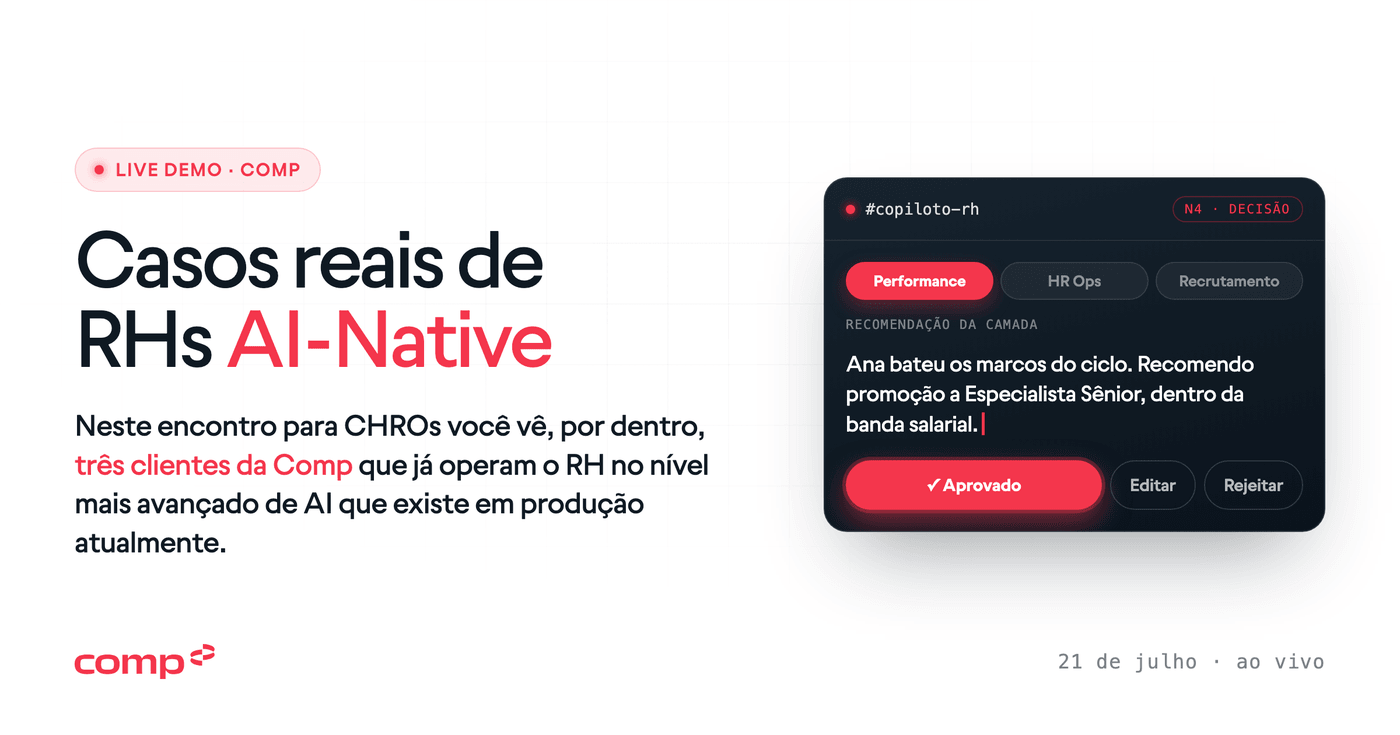
Real cases of AI-Native HR teams
Pedro Bobrow (Co-founder & CHRO at Comp) walks through three HR operations running AI-Native at the N4 level: recruiting at a scale-up (~500 people, from 29h to 6h of manual work, involuntary turnover from 18% to 8%), continuous performance at a unicorn (2,000 people, nearly 100% of reviews completed), and HR Ops at an enterprise (5,000+, operational work from 50% to 7% of the time). With Q&A.
Watch the recording →Private dinner · Aug 5 · São Paulo
CHROs in AI dinner · with Gianpiero Sperati (Creditas)
Private dinner at Comp House with Gianpiero Sperati (Director of People & Performance at Creditas) and Guilherme Tomazin (Comp), bringing together ~30 CHROs around AI in HR. Limited spots, request yours (subject to approval).
Private breakfast · Aug 7 · São Paulo
CHROs in AI breakfast · with Daniel Campos (Sem Parar Corpay)
Private breakfast at Comp House with Daniel Campos (CHRO at Sem Parar Corpay) and Filipe Ducas (Comp), with conversations about AI for HR among ~30 CHROs. Limited spots, request yours.
Article
Being AI-Native for real: what changes when HR stops automating
Coverage of Pedro Bobrow's talk at the Humanship MeetUp, at Casa Comp: being AI-Native is rethinking whether the process should exist, before automating it, and designing HR around the employee who uses it, rather than optimizing for the department itself.
Podcast
Rethinking People #2 · Antonio Salvador (InterCement)
New episode of Rethinking People with Antonio Salvador (CHRO at InterCement) on bringing AI to HR at an industrial multinational, outside the tech circuit.
That's issue three.
If it earned your time, forward it to one person who should be reading along.

More from the Memo
Issue 02 · July 13, 2026
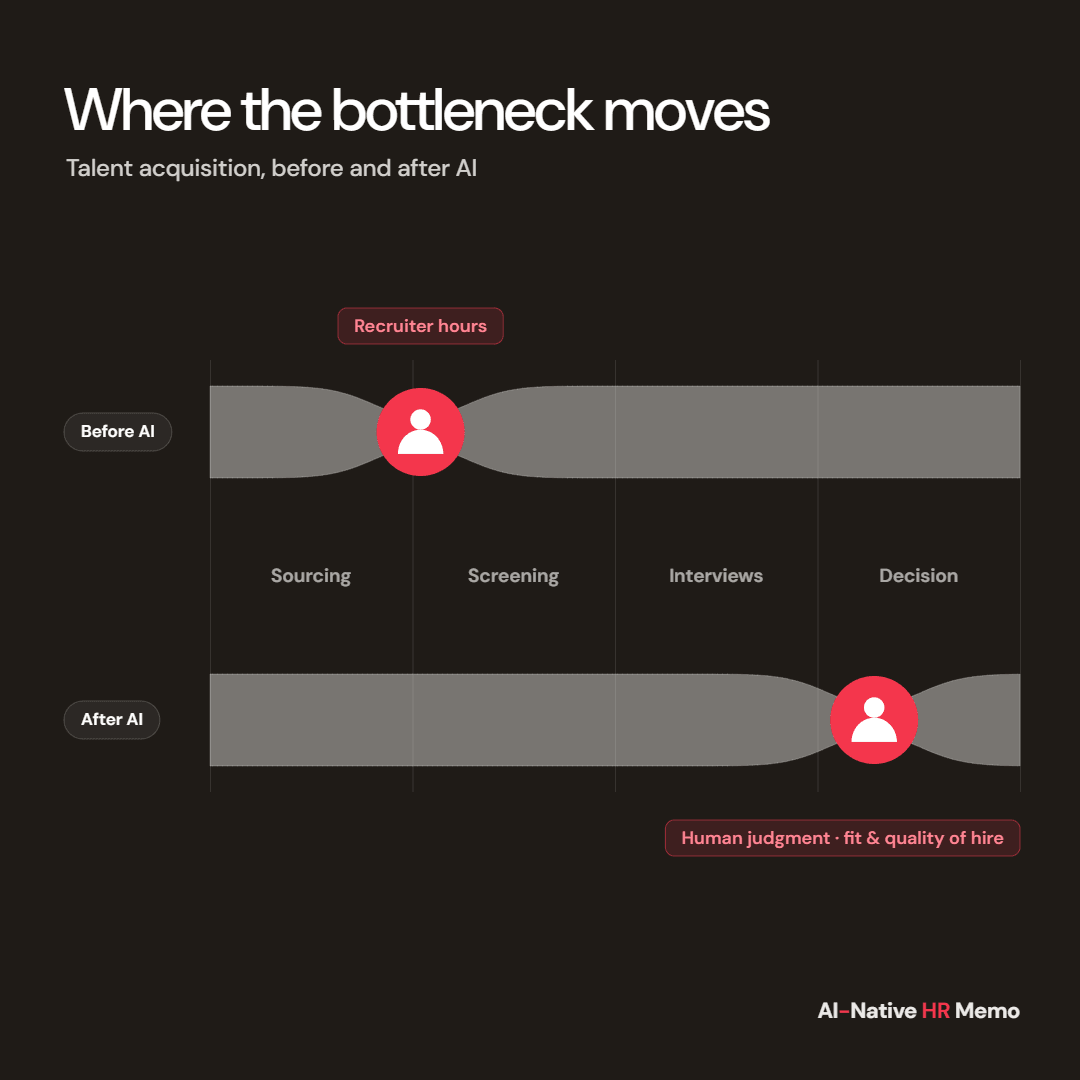
What AI actually changes about hiring
When sourcing and screening cost almost nothing, the recruiting bottleneck becomes judgment about fit and quality of hire. The thesis applied to talent acquisition.
Read issue
Issue 01 · June 22, 2026
AI changes what HR is made of
When intelligence becomes cheap and continuous, four constraints that defined HR for decades dissolve. The thesis that opens the Memo.
Read issue