Edition 01 · June 22, 2026
AI changes what HR is made of
Chris Gerlach · Co-Founder and CEO, Comp · ~10 min read
Editorial
Welcome to the AI-Native HR Memo. We at Comp built this newsletter for the people deciding what AI does inside their companies: CEOs, founders, CHROs, and the senior People leaders pushing the function forward from inside.
The world has plenty of content about AI in HR. We built this for the part that's still in short supply: a point of view sharp enough to be worth ten minutes of a busy person's time. Every issue brings one piece of original thinking with a position we'd defend in a room of skeptics, plus a few signals from the field we think you'll find worth keeping an eye on. The goal is for you to walk away with at least one idea you couldn't have gotten by skimming LinkedIn the same week.
This is the lens we have, and where it comes from matters. We sit at the bridge between Brazilian tech and Silicon Valley, with a regular seat inside the HR operations of the country's most innovative tech companies, not at arm's length. The work we do for them, building AI-native HR, runs at the frontier of what AI today can actually deliver. That's the angle we write from.

We're opening with the piece that sets the lens for everything else we'll publish here.
Most of what gets written about AI in HR treats the technology as an accelerator. The same processes, the same forms, the same cycles, run faster. Resumes screened in seconds. The merit cycle built in days instead of weeks. The policy question answered before the employee finishes typing it. Read that way, the HR function looks roughly the same before and after AI, only with shorter cycle times.
We at Comp believe that read is wrong, and it explains why most HR AI initiatives we see in the field are producing sophisticated execution and stagnant quality.
When intelligence becomes cheap and continuous, four structural constraints that have defined every People process for decades quietly dissolve.
- Cadence. HR has always been episodic (the quarterly review, the annual cycle, the biannual survey), because human attention had to be rationed onto a calendar. With analysis continuous and nearly free, the calendar stops being the organizing principle. Work becomes event-driven.
- Data. HR has always run on structured, self-reported data (the rating in the HRIS, the skill someone typed into their profile, the box checked on a survey). When a model reads the unstructured signal directly (commits, call transcripts, documents, Slack threads), the self-report becomes one weak signal among many.
- Coverage. HR has always worked from samples (calibrate a slice, audit a subset, escalate the outliers). When the full population is in scope by default, sampling stops being methodology and becomes a liability.
- The human's role. HR professionals and managers used to be the executors of the function. After AI, the system does the synthesis and proposes the call. The human's job inverts to judging it: approving, editing, rejecting.
These four shifts add up to one implication most companies are missing: the job AI does in HR is to change what the function is made of, including its cadence, its data, its coverage, and the role of the human inside it. Faster cycle times are a side effect of that change. Confusing the side effect for the goal is the trap most initiatives fall into.
Over the next two weeks, we'll publish one breakdown per HR sub-function on LinkedIn (talent acquisition, performance, total rewards, people analytics, org design, L&D, and HR operations), with the same lens applied to each. A consolidated working paper follows soon after.
After reading, let us know what you thought of this piece. The newsletter compounds when you do.
Hope you enjoy what follows,
Chris Gerlach · Co-Founder & CEO, Comp
Spotlight
Manoela Mitchell · CEO, Pipo Saúde
Healthtech · ~200 people
AI-native right at the front door: Mano rebuilt a document many people treat as bureaucracy — the offer letter.
What changed in Pipo's offer:
- Moved out of PowerPoint, became an HTML page
- Describes the AI stack the person will use day to day
- States the token budget each engineer will have
“Our offer letter used to be a PowerPoint. Now it's an HTML. We talk about the AI stack you're going to use at the company, and the number of tokens you'll have access to as an engineer here.”
Manoela Mitchell · CEO, Pipo Saúde
The offer letter stopped promising an AI-native culture and started proving it, at first contact. It's a document any HR team can rebuild.
Reads
Worth reading before the next edition
Every · Essay · May 21
After Automation
Shipper captures an intuition that matters: the edge AI gives today turns into a commodity fast, and what separates the people who differentiate becomes who judges best what AI produces. In HR, the read is direct. The CHRO has to move from the execution layer (where decisions depend on what the manager remembers) to the definition layer: what the system optimizes, on what data, with which guard-rails.
Anthropic · Playbook · May 14
The Founder's Playbook: Building an AI-Native Startup
Anthropic published an excellent playbook on building AI-native startups. The document describes the operation that's becoming the standard: founder as orchestrator of agents, a lean team by design, operational weight pushed to AI to free humans for the judgment calls. The line that ties it together appears at the end: "judgment calls become your moat". For HR at a consolidated scale-up, the useful exercise is to look at this operation as a future benchmark. The next startups are born with the People function designed AI-native, inside the mold described here.
Fortune · News · May 19
Bolt CEO says he let go of his entire HR team
The news made waves. Bolt cut its HR team and the CEO publicly stated that "those problems disappeared when I let them go". A common read has been circulating that this is the future for all of HR, with AI in its place. It's worth separating signal from noise. What Bolt cut was HR as an executor of transactional processes; what they kept (under the name "smaller People Ops") is what's left when the operation goes lean: the judgment part. The useful question for anyone running HR at a consolidated scale-up is what share of the current team sits in each of the two categories.
Y Combinator · Talk · May 19
How to Build a Self-Improving Company with AI
The core argument of this video is structural. YC proposes that a company can be architected as a set of recursive AI loops, with sensors, decisions, tools, quality and learning feeding back into the system. Recruiting, performance and compensation fit exactly that design: each human decision (an approval, a calibration, a promotion) becomes a training signal for the loop, which compounds quality over time.
The CHRO Office · Essay · May 24
The HR role is ending because of AI
Wang describes a real problem well: only 21% of HR leaders are involved in their own company's AI strategy. His prescription falls short, though. He recommends the CHRO use AI day to day and talk to the CEO, which is tactical. The transformation underway is structural (cadence, data, coverage, the human's role) and the way out runs through moving the function to a maturity level where AI becomes infrastructure.
Demo
The highest level of AI maturity in HR running in production (for now)
 Watch · video
In our read, this use case represents the highest level of AI adoption maturity in HR running in production today: an agentic layer integrated across every system and database in the operation, able to judge, proactively recommend actions, and operate end to end.
In the video, the agent spotted higher-than-expected turnover in the marketing team, investigated on its own (HRIS, ATS, exit reason, salary band, market), built the diagnosis, got the necessary approval, executed across every system involved, and already scheduled the 30-, 60- and 90-day follow-ups.
Some of Comp's HR partners already operate at this level of maturity.
Featured
Where Comp has been in recent weeks
Open material to revisit.
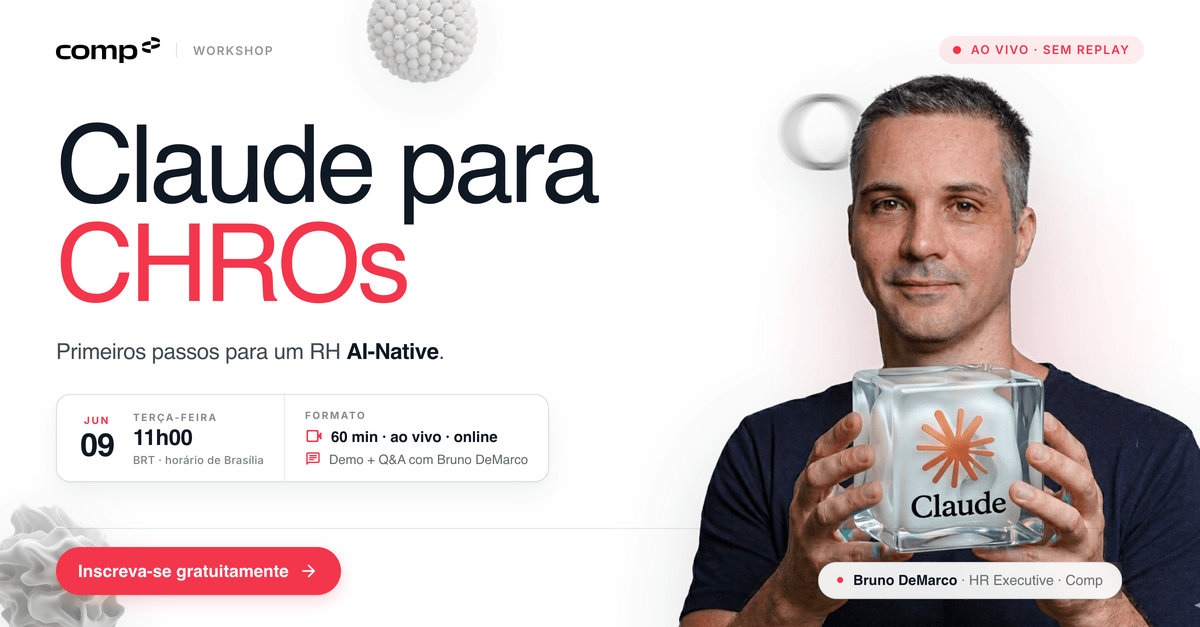
Claude para CHROs · com Bruno DeMarco
Hands-on session with Bruno DeMarco (HR Exec at Comp, 15+ years leading HR at Dock, CVC, Lenovo). Practical AI demos for offer letters, performance reviews and strategic People decisions. No technical prerequisite.
Watch the recording →White paper · Comp
AI-native in 5 levels: AI adoption maturity
Comp's 5-level framework for diagnosing AI adoption maturity in organizations. It documents what changes in the operation at each level, from L1 (AI as individual productivity) to L5 (AI as adaptive intelligence).
Event · May 19 · São Paulo
SOMA 2026 · Encontro de Remuneração & Benefícios
The third edition of SOMA, Comp's gathering for Total Rewards leaders. 500+ people and 12 companies on stage. Highlight: our panel "Org Design in the age of AI", moderated by Filipe Ducas (co-founder, Comp) with leaders from Google, IBM and XP on how AI is redesigning the role of HR inside organizations.
Private dinner · Jun 01 · São Paulo
CHROs in Tech Dinner
Another edition of the CHROs in Tech Dinner, at Comp House. Tatiana Romero (Director of HR & Sustainability, Edenred) was the night's guest, with Filipe Ducas leading the conversation. Among the topics: how a good EVP respects the reality of each business, and why "AI First" has to be treated as cultural transformation. One insight that stuck: good AI governance educates before it blocks.
That's the first issue.
If it earned your time, forward it to one person who should be reading along.

Continue in the Memo
Edition 02 · July 13, 2026
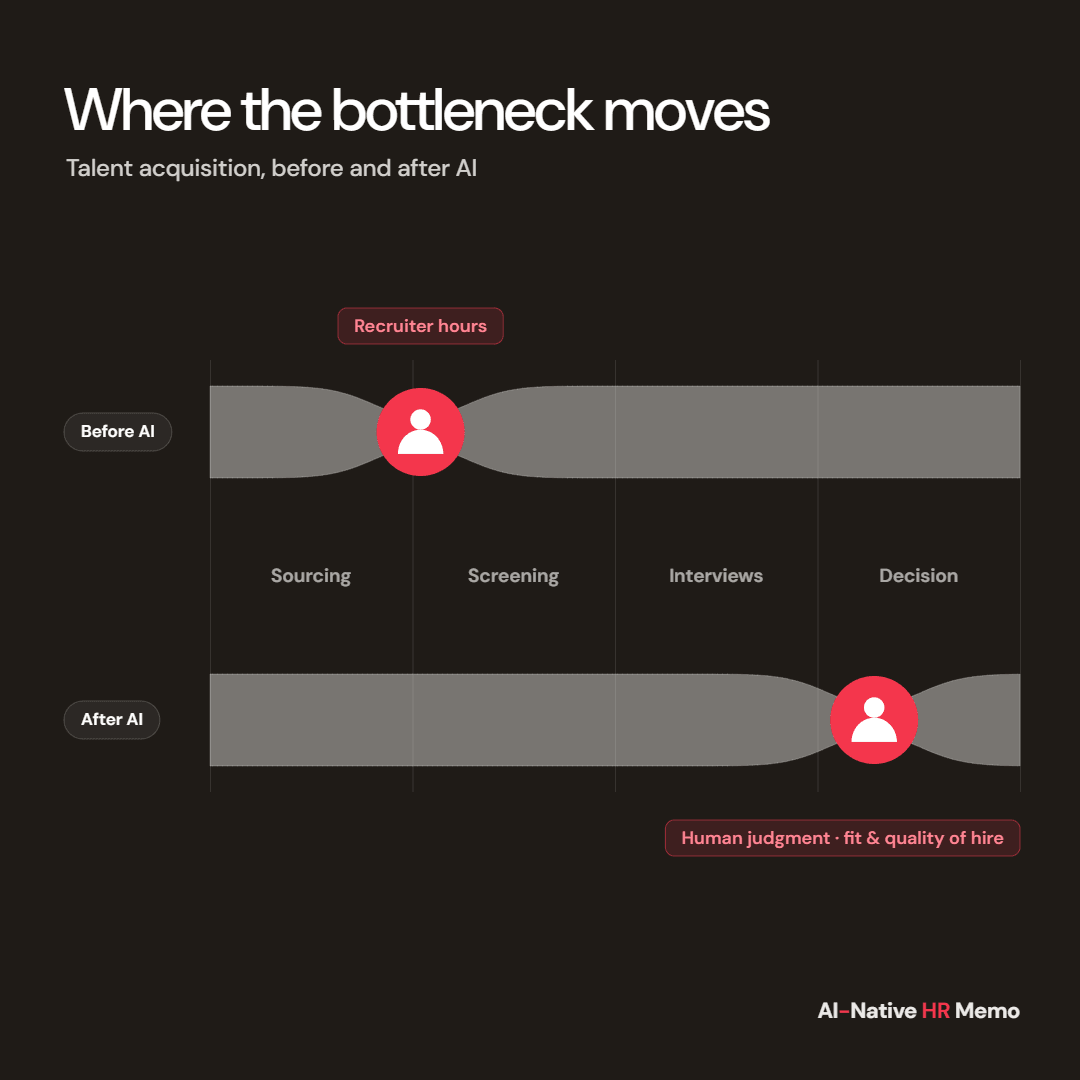
What AI actually changes about hiring
The recruiting funnel gets faster, but that's the least interesting part. When sourcing and screening cost almost nothing, the bottleneck becomes judgment and the whole pipeline reorganizes. The thesis applied to talent acquisition.
Read editionEdition 03 · coming soon
Subscribe to get it first.