
Issue 02 · July 13, 2026
What AI actually changes about hiring
Chris Gerlach · Co-Founder and CEO, Comp · ~8 min read
Original thinking on AI-Native HR, for the CHROs and CEOs deciding what AI does inside their company.
Editorial
Since I first took an interest in HR, I've read my fair share. I came to it sideways, starting my career as an investor covering HRtech theses rather than as an HR operator, which has its pros (a broader macro view) and cons (no lived HR-operator experience). One thing stuck with me from the start of my time studying HR: the people decisions that shape a company most (who it hires, who it promotes) tend to be the ones made with the most human bias, hiring on vibes and promoting whoever is best at playing politics, not whoever delivers the most real value. Closing that gap is a large part of what we at Comp have worked on since.
I'd confidently say that almost everything written about AI in recruiting describes a similar funnel, just running faster: more sourcing, quicker screening, résumés read in seconds. That is real, but it is the least interesting part of what is happening. The first issue of this memo argued that AI changes what the HR function is made of, its cadence, its data, its coverage, and the role of the human inside it. That was the general case; this issue puts it to work on one sub-function, talent acquisition.
Recruiting was built to optimize for speed and volume for one reason: a recruiter’s hours were the bottleneck. Every decision downstream of that, from keyword filters to sampled reviews to time-to-fill as the metric that mattered, was a workaround for scarce human attention. When the cost of sourcing and screening falls to near zero, the bottleneck relocates downstream, onto the one thing cheap compute cannot (yet) solve: judgment about fit and quality of hire. The whole pipeline then reorganizes around where the constraint now sits.
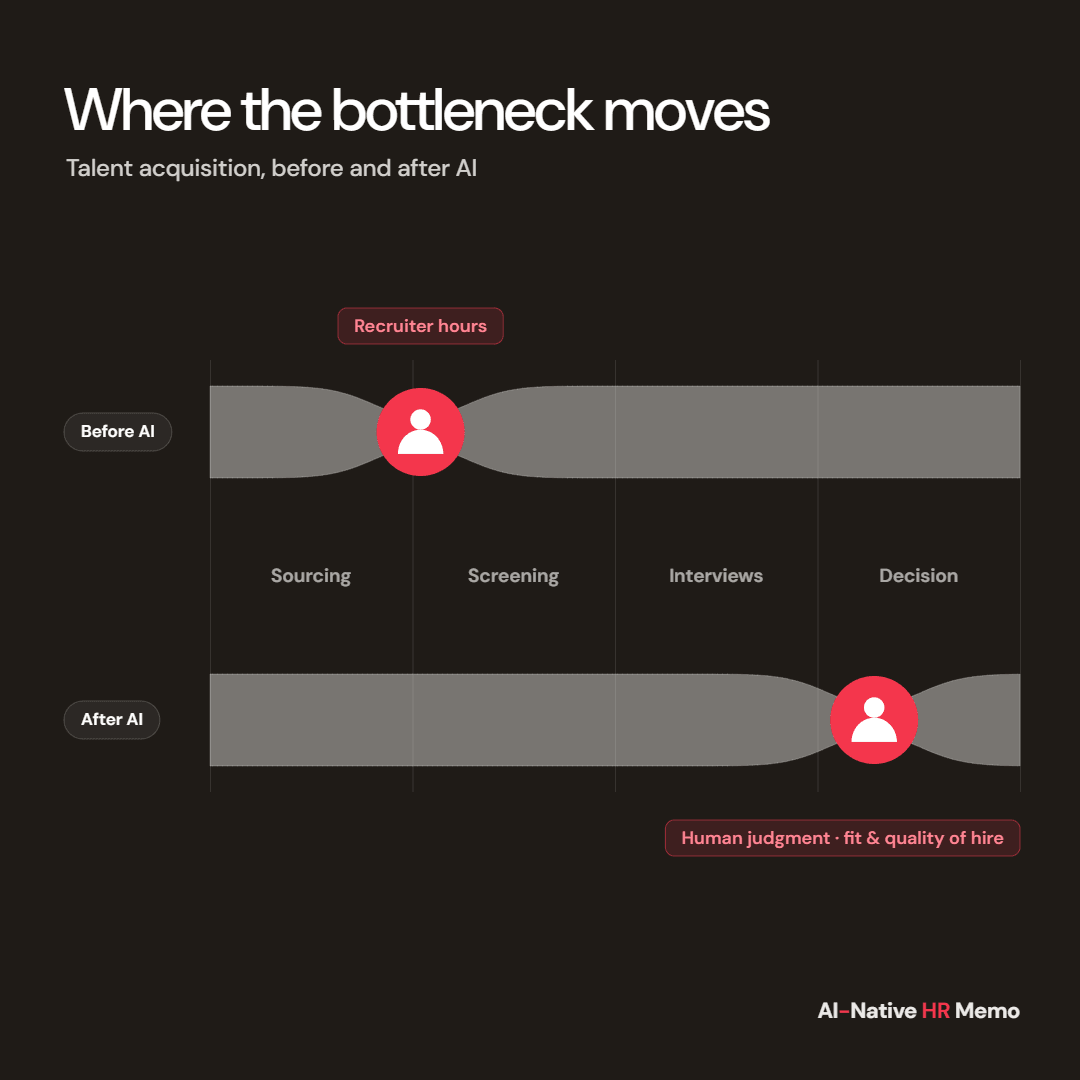
Three consequences follow, and none of them is about speed.
The first: recruiting finally gets to optimize for the number it always wanted. Time-to-fill was only ever a proxy, the metric recruiting could measure while the one that mattered (quality of hire) stayed out of reach because the loop was too long and too manual to close. When an agent sources and the loop runs one step further, a candidate is hired and then performs well three or six months in, the signal of what a strong hire looks like for that role feeds back on its own. The pipeline gets more targeted over time without anyone recalibrating it by hand.
The second: the screen stops matching keywords and starts evaluating the full applicant population against what actually predicted success in that role. That is exactly where bias gets audited out or quietly amplified at scale, depending on whether you can see how the model decided, which is why explainability stops being a compliance checkbox and becomes a design requirement.
The third is quieter and easy to miss. The same skills graph that powers external sourcing also indexes the people already inside the company, so every open role can be matched against internal candidates before it is ever posted. “Internal-first” stops being a mobility policy that everyone endorses (but almost no one follows) and becomes the default path, because the fastest and cheapest match is usually already an employee.
None of this is theory for us. We have been running recruiting at Comp with no dedicated recruiter team. Leaders do their own hunting and interviewing, and AI does the operational lifting. Everything about how we hire lives in one self-improving document the AI reads for context, from our talent philosophy to our pay policy. Assessments are binary (a 0 or a 1) with no fence-sitting; no interviewer sees another’s write-up before submitting their own; and after each round the AI drafts the assessment from the transcript for the interviewer to edit, learning from every edit. Offers generate against our salary table and anything off-standard routes to me.
Now, look at where the human sits in all of that. The operational parts that ate most of the week fall away, and the work that matters moves up rather than disappearing: to building relationships, to selling the opportunity, to the conversations that decide a hire, and to the judgment about fit. That judgment is the discipline that compounds. Every time one of us edits an AI-drafted assessment or approves a shortlist, that call either ends with that one hire or feeds back to sharpen the next recommendation, and only the second kind makes next quarter’s hiring better than this one’s.
Next in this series, the same lens on performance and development.
Once again, let us know what you thought of this piece. The newsletter compounds when you do.
Hope you enjoy what follows,
Chris Gerlach · Co-Founder & CEO, Comp
Spotlight
Gonzalo Parejo · Founder & CEO, Kamino
Fintech · Series A · São Paulo
When one of Kamino's areas hits a growth ceiling, Gonzalo's first move is to look at how that team is using AI and what's holding the output back. Hiring comes only after.
“Prior to AI, racing around and being able to hire a lot of people was a great signal. Now things have completely changed. (...) If that area is having strong constraints in terms of growth, we don't think the first option to hire more people. We think about how that team is actually using AI and how can we help that area be more productive.”
Gonzalo Parejo · Founder & CEO, Kamino
Workforce planning, leveling, and the way a team's output gets read were all built on headcount, but they need to be rethought once the measure becomes the capacity to execute.
Reads
Worth reading before the next issue
Ramp + Revelio Labs · Paper · Jun 30
A New Look at AI's Impact on Jobs
Ramp cross-referenced real AI spend from 21,000 U.S. companies with headcount data in one of the first studies of its kind. The easy headline would be “AI creates jobs”: adopters grow headcount ~10% and entry-level rises as much as ~12%. What matters is the split by intensity: the gain shows up only among high-intensity adopters, with sustained, material investment. The companies that stayed on chat subscriptions and project pilots saw no relevant change (the paper is explicit that “enterprise chat subscriptions do not appear to be enough”). What drives results is operational depth and redesigning workflows from first principles. The authors even admit they don't specifically know which practices most impact the business (and, by extension, headcount), because whoever figured it out has no incentive to tell.
PwC · Report · Jun
Two futures for jobs in an AI era
PwC's Global AI Jobs Barometer reaches a similar diagnosis by a different route: the companies most exposed to AI hired more and paid more, with a wage premium around 62% for AI skills and a strong “superstar” effect (the top 20% with +163% productivity). The most exposed junior roles started to demand judgment and leadership, once reserved for senior people. Cross-referenced with the Ramp paper above, which shows entry-level headcount rising among intense adopters, the following picture takes shape: the entry role still exists, now with a higher bar for judgment from day one. For anyone recruiting, it changes the profile you look for, the onboarding, and the leveling.
Demo
End-to-end recruiting, humans only on the decisions
 Watch · video
The way we read it, recruiting is one of the clearest places where the jump to N4 shows up: you can run the entire process, from opening the role to the offer letter, with almost zero operational work.
In the video, Pedro Bobrow (Co-founder & CHRO at Comp) shows the agentic layer opening the role from the manager's request, screening with a model built for that specific company (to the point of recommending the candidate for a seat different from the one she applied to), scheduling the interviews, and building the offer from the compensation policy. The human steps in only on the decisions, as a judge, and each one becomes context for the next, making the recommendations better over time.
Some of Comp's partner HR teams already run recruiting at this level.
Featured
From Comp: to be in the room (and to revisit later)
Live events and materials worth revisiting.
Real cases of AI-Native HR teams (live demo)
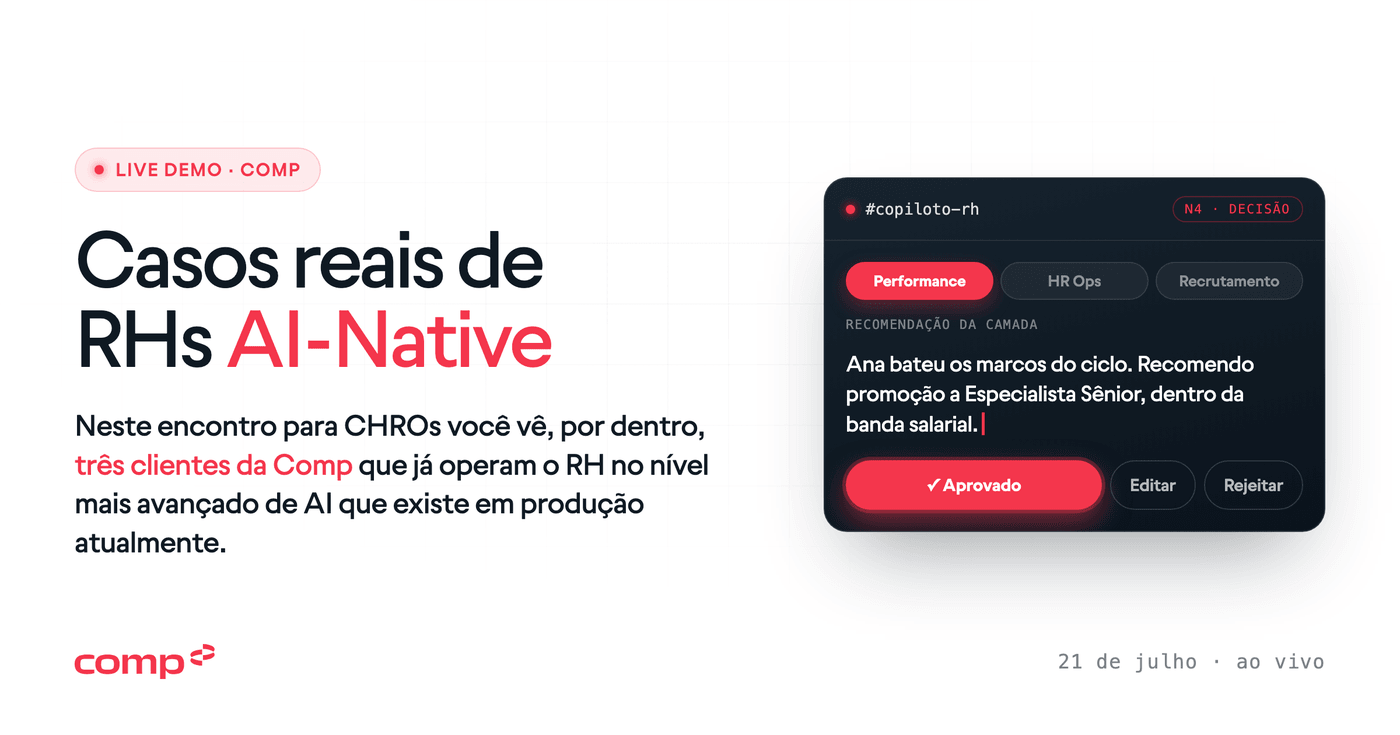
Live demo with Pedro Bobrow (Co-founder & CHRO at Comp) walking through three HR operations running AI-Native at the N4 level (decision intelligence): a traditional industrial company (~1,000 people) with continuous performance guided by AI recommendations; an enterprise (5,000+) with HR operations under human approval; and a tech scale-up (500+) with the recruiting funnel end to end. Live, with Q&A. Recording released to everyone who registers.
Save my spot →Private dinner · Comp House
CHROs in AI Dinner · with Gleycia Leite (Natura)
Another edition of the CHROs in AI Dinner at Comp House, with Gleycia Leite (HR Director at Natura) and Filipe Ducas hosting. The thread of the conversation: AI transformation in HR starts with leadership itself getting familiar with the technology, with HR in the lead.
Event · Campinas
Humanship Experience · “Culture in transformation” panel
Comp on stage at the 2nd Humanship Experience (150+ CHROs and HR leaders). The panel “Culture in transformation: HR's decisions, practices, and paths today”, moderated by Guilherme Tomazin (Revenue Owner, Comp), with Andrea Milan (CHRO, Banco BMG), Marcela Ziliotto (CHRO, Pipo Saúde), and Wellington Silverio (HR Director LATAM, John Deere).
That's issue two.
If it earned your time, forward it to one person who should be reading along.

More from the Memo

Issue 01 · June 22, 2026
AI changes what HR is made of
When intelligence becomes cheap and continuous, four constraints that defined HR for decades dissolve. The thesis that opens the Memo.
Read issueIssue 03 · coming soon
The next thesis is already being written.