
Edição 01 · 22 de junho de 2026
AI changes what HR is made of
Chris Gerlach · Co-Founder e CEO, Comp · ~10 min de leitura
Editorial
Welcome to the AI-Native HR Memo. We at Comp built this newsletter for the people deciding what AI does inside their companies: CEOs, founders, CHROs, and the senior People leaders pushing the function forward from inside.
The world has plenty of content about AI in HR. We built this for the part that's still in short supply: a point of view sharp enough to be worth ten minutes of a busy person's time. Every issue brings one piece of original thinking with a position we'd defend in a room of skeptics, plus a few signals from the field we think you'll find worth keeping an eye on. The goal is for you to walk away with at least one idea you couldn't have gotten by skimming LinkedIn the same week.
This is the lens we have, and where it comes from matters. We sit at the bridge between Brazilian tech and Silicon Valley, with a regular seat inside the HR operations of the country's most innovative tech companies, not at arm's length. The work we do for them, building AI-native HR, runs at the frontier of what AI today can actually deliver. That's the angle we write from.
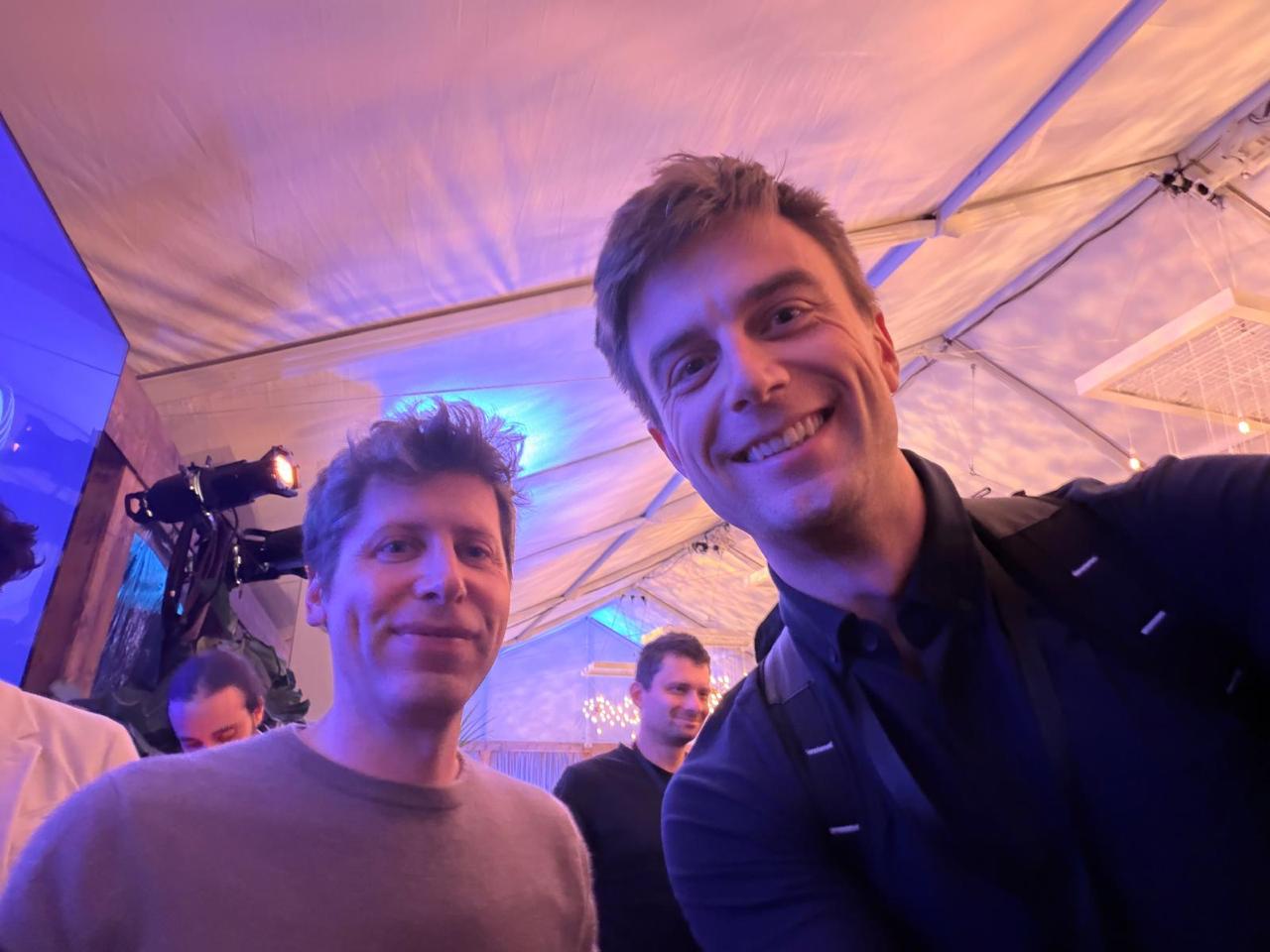
We're opening with the piece that sets the lens for everything else we'll publish here.
Most of what gets written about AI in HR treats the technology as an accelerator. The same processes, the same forms, the same cycles, run faster. Resumes screened in seconds. The merit cycle built in days instead of weeks. The policy question answered before the employee finishes typing it. Read that way, the HR function looks roughly the same before and after AI, only with shorter cycle times.
We at Comp believe that read is wrong, and it explains why most HR AI initiatives we see in the field are producing sophisticated execution and stagnant quality.
When intelligence becomes cheap and continuous, four structural constraints that have defined every People process for decades quietly dissolve.
- Cadence. HR has always been episodic (the quarterly review, the annual cycle, the biannual survey), because human attention had to be rationed onto a calendar. With analysis continuous and nearly free, the calendar stops being the organizing principle. Work becomes event-driven.
- Data. HR has always run on structured, self-reported data (the rating in the HRIS, the skill someone typed into their profile, the box checked on a survey). When a model reads the unstructured signal directly (commits, call transcripts, documents, Slack threads), the self-report becomes one weak signal among many.
- Coverage. HR has always worked from samples (calibrate a slice, audit a subset, escalate the outliers). When the full population is in scope by default, sampling stops being methodology and becomes a liability.
- The human's role. HR professionals and managers used to be the executors of the function. After AI, the system does the synthesis and proposes the call. The human's job inverts to judging it: approving, editing, rejecting.
These four shifts add up to one implication most companies are missing: the job AI does in HR is to change what the function is made of, including its cadence, its data, its coverage, and the role of the human inside it. Faster cycle times are a side effect of that change. Confusing the side effect for the goal is the trap most initiatives fall into.
Over the next two weeks, we'll publish one breakdown per HR sub-function on LinkedIn (talent acquisition, performance, total rewards, people analytics, org design, L&D, and HR operations), with the same lens applied to each. A consolidated working paper follows soon after.
After reading, let us know what you thought of this piece. The newsletter compounds when you do.
Hope you enjoy what follows,
Chris Gerlach · Co-Founder & CEO, Comp
Spotlight
Manoela Mitchell · CEO, Pipo Saúde
Healthtech · ~200 pessoas
AI-native já na porta de entrada, a Mano refez um documento que muita gente trata como burocracia: a carta-proposta.
O que mudou na oferta da Pipo:
- Saiu do PowerPoint, virou uma página HTML
- Descreve o AI stack que a pessoa vai usar no dia a dia
- Informa o budget de tokens que cada engenheiro terá
“Our offer letter used to be a PowerPoint. Now it's an HTML. We talk about the AI stack you're going to use at the company, and the number of tokens you'll have access to as an engineer here.”
Manoela Mitchell · CEO, Pipo Saúde
A carta-proposta deixou de prometer cultura AI-native e passou a provar, no primeiro contato. É um documento que qualquer RH consegue refazer.
Leituras
O que vale ler antes da próxima edição
Every · Ensaio · 21 Mai
After Automation
Shipper captura uma intuição que importa: a vantagem que AI dá hoje vira commodity rapidamente, e o que separa quem se diferencia passa a ser quem julga melhor o que a AI produz. Em RH, a leitura é direta. O CHRO precisa migrar do plano de execução (em que decisões dependem do que o gestor lembra) para o plano de definição: o que o sistema otimiza, em quais dados, com que guard-rails.
Anthropic · Playbook · 14 Mai
The Founder's Playbook: Building an AI-Native Startup
A Anthropic publicou um excelente playbook sobre construir startups AI-native. O documento descreve a operação que está virando padrão: founder como orquestrador de agentes, time enxuto por design, peso operacional empurrado pra AI pra liberar os humanos pras judgment calls. A frase que amarra a ideia aparece no fim do documento: "judgment calls become your moat". Pra RH em scale-up consolidada, o exercício útil é olhar essa operação como benchmark futuro. As próximas startups nascem com a função de pessoas desenhada AI-native dentro do molde descrito aqui.
Fortune · Notícia · 19 Mai
Bolt CEO says he let go of his entire HR team
A notícia repercutiu. A Bolt cortou seu time de RH e o CEO declarou em público que "those problems disappeared when I let them go". Tem circulado uma leitura comum de que esse é o futuro pra todo RH, com AI no lugar. Vale separar o sinal do ruído. O que a Bolt cortou foi o RH como executor de processos transacionais; o que mantiveram (sob o nome de "People Ops menor") é o que sobra quando a operação fica enxuta: a parte de judgment. A pergunta útil pra quem opera RH em scale-up consolidada é qual proporção do time atual está em cada uma das duas categorias.
Y Combinator · Talk · 19 Mai
How to Build a Self-Improving Company with AI
O argumento central deste vídeo é estrutural. A YC propõe que uma empresa pode ser arquitetada como um conjunto de loops recursivos de AI, com sensores, decisões, ferramentas, qualidade e aprendizado retroalimentando o sistema. Recrutamento, performance e remuneração comportam exatamente esse desenho: cada decisão humana (uma aprovação, uma calibração, uma promoção) vira sinal de treino do loop, que compõe qualidade com o tempo.
The CHRO Office · Ensaio · 24 Mai
The HR role is ending because of AI
Wang descreve bem um problema real: só 21% dos HR leaders estão envolvidos na estratégia de AI da própria empresa. A prescrição dele fica curta, porém. Recomenda que o CHRO use AI no dia a dia e converse com o CEO, o que é tático. A transformação que está acontecendo é estrutural (cadence, dados, cobertura, papel do humano) e a saída passa por mover a função pra um nível de maturidade onde AI vira infraestrutura.
Demo
O nível mais alto de maturidade de AI em RH em produção (por enquanto)
 Assistir · vídeo
Na nossa leitura, esse caso de uso representa o nível mais alto de maturidade de adoção de AI em RH em produção hoje: uma camada agêntica integrada em todos os sistemas e bases de dados da operação, com capacidade de julgar, recomendar ações de forma proativa, e operar do começo ao fim.
No vídeo, o agente identificou um turnover acima do esperado no time de marketing, investigou sozinho (HRIS, ATS, motivo de saída, banda salarial, mercado), montou o diagnóstico, pegou a aprovação necessária, executou em todos os sistemas envolvidos, e já agendou os follow-ups de 30, 60 e 90 dias.
Alguns dos RHs parceiros da Comp já operam nesse nível de maturidade.
Featured
Onde a Comp esteve nas últimas semanas
Material aberto para revisitar.
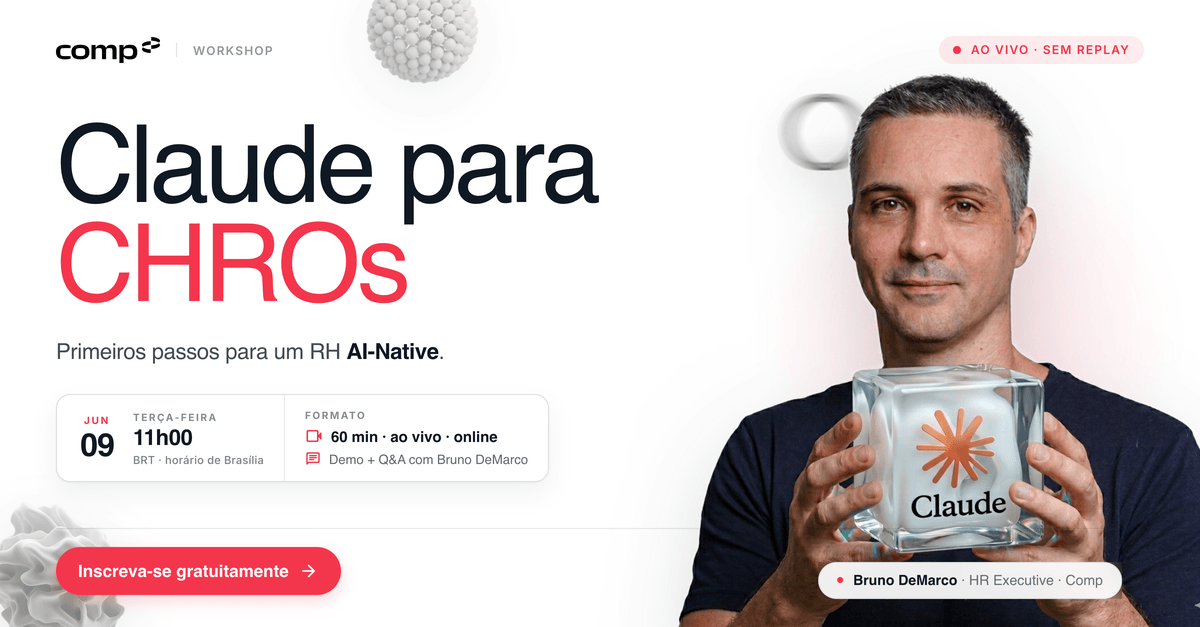
Claude para CHROs · com Bruno DeMarco
Sessão hands-on com Bruno DeMarco (HR Exec na Comp, 15+ anos liderando RH em Dock, CVC, Lenovo). Demos práticas de AI para offer letters, performance reviews e decisões estratégicas de People. Sem pré-requisito técnico.
Assistir à gravação →White paper · Comp
AI-native in 5 levels: AI adoption maturity
Framework da Comp em 5 níveis para diagnóstico de maturidade de adoção de AI em organizações. Documenta o que muda na operação em cada nível, do N1 (AI como produtividade individual) ao N5 (AI como inteligência adaptável).
Evento · 19 Mai · São Paulo
SOMA 2026 · Encontro de Remuneração & Benefícios
Terceira edição do SOMA, encontro Comp para líderes de Total Rewards. 500+ pessoas e 12 empresas no palco. Destaque para o nosso painel "Org Design in the age of AI", moderado por Filipe Ducas (co-founder Comp) com líderes de Google, IBM e XP sobre como AI está redesenhando o papel do RH dentro das organizações.
Jantar fechado · 01 Jun · São Paulo
CHROs in Tech Dinner
Mais uma edição do CHROs in Tech Dinner, na Comp House. Tatiana Romero (Diretora de RH & Sustentabilidade, Edenred) foi a convidada da noite, com Filipe Ducas conduzindo a conversa. Entre os temas: como um bom EVP respeita a realidade de cada negócio, e por que "AI First" precisa ser tratado como transformação cultural. Um insight que ficou: boa governança em AI educa antes de bloquear.
That's the first issue.
If it earned your time, forward it to one person who should be reading along.

Continue na Memo
Edição 02 · 13 de julho de 2026
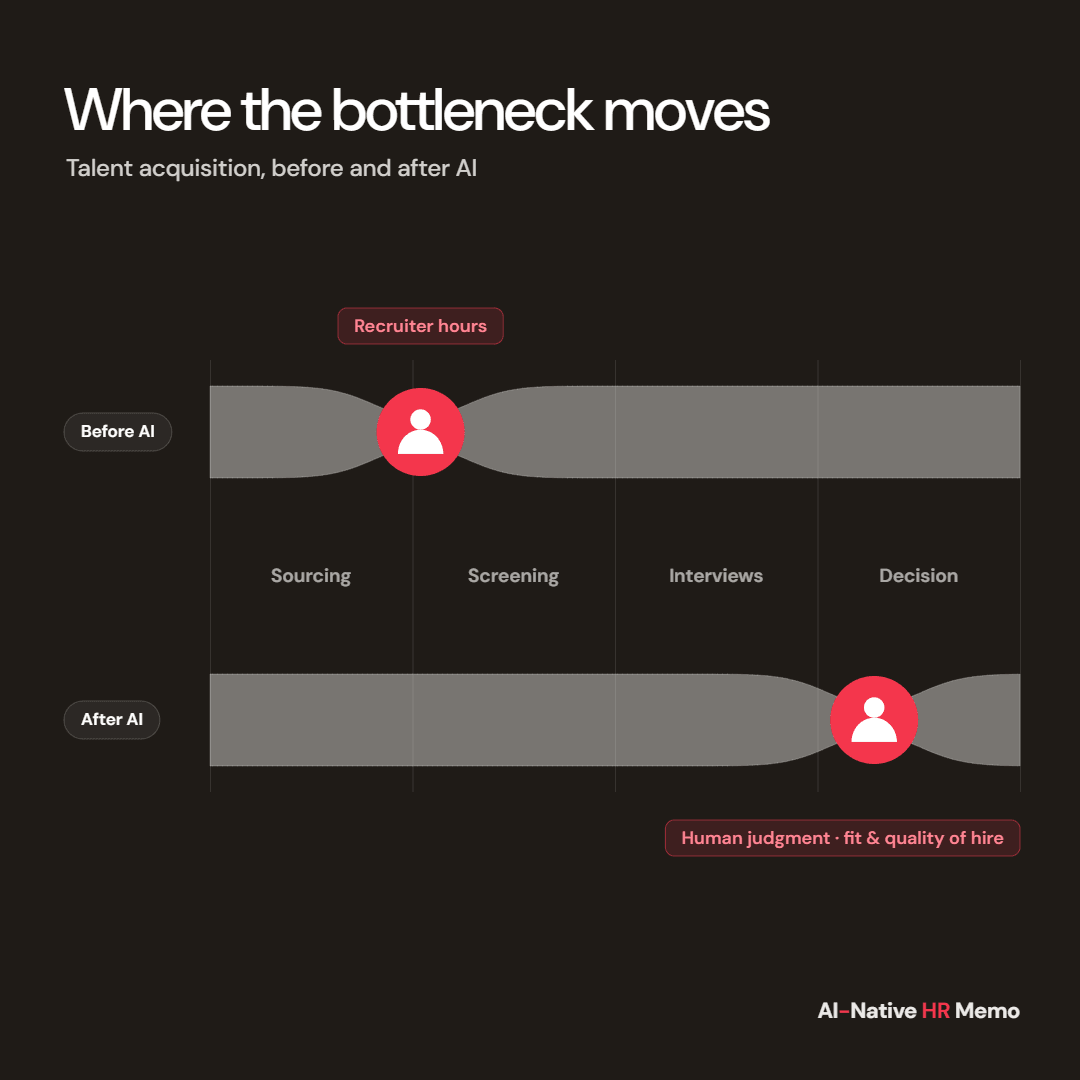
What AI actually changes about hiring
O funil de recrutamento fica mais rápido, mas essa é a parte menos interessante. Quando sourcing e screening custam quase zero, o gargalo vira o julgamento e o pipeline inteiro se reorganiza. A tese aplicada a talent acquisition.
Ler edição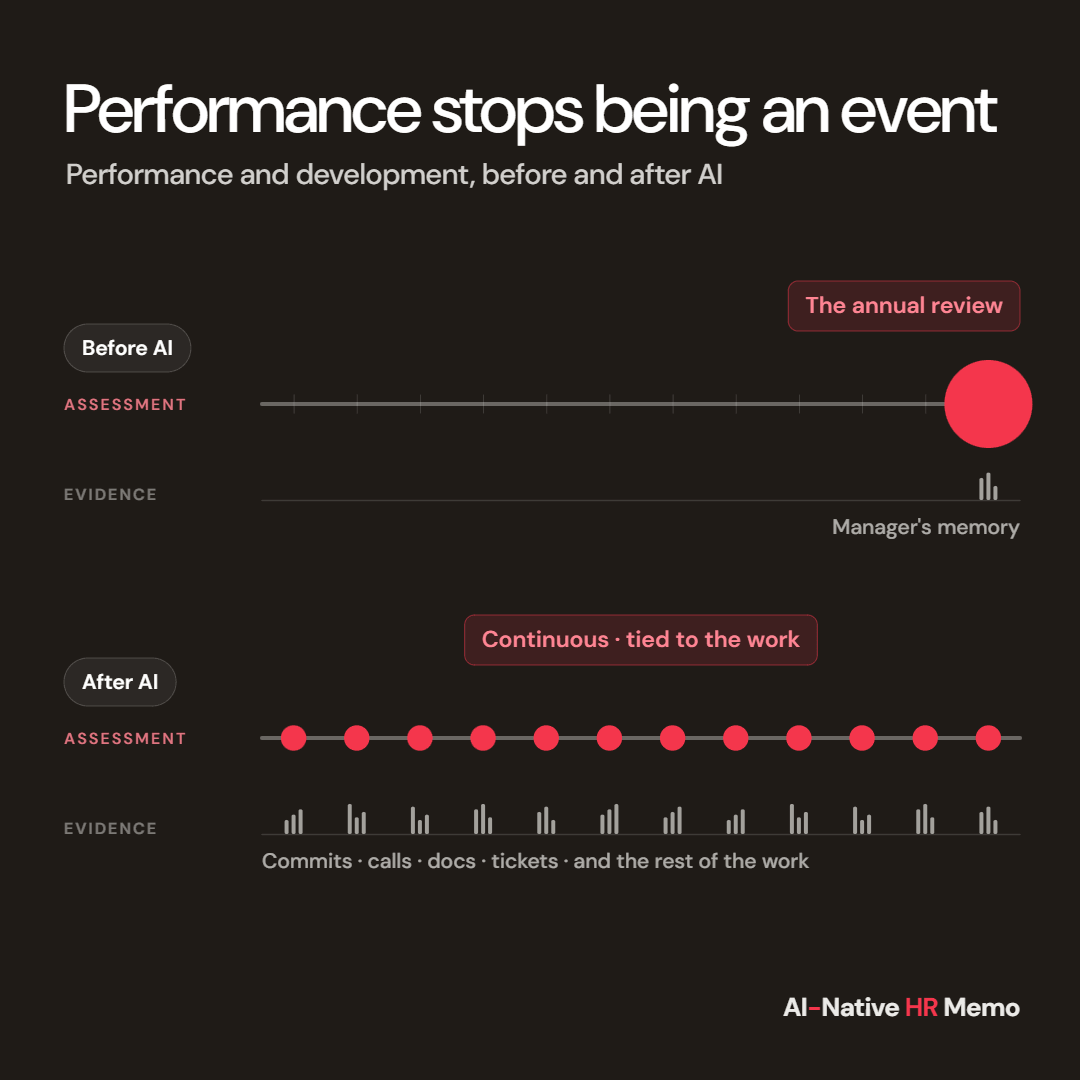
Edição 03 · 28 de julho de 2026
A performance review shouldn't be an annual event
Quando a AI lê o trabalho de verdade, a performance deixa de ser um evento anual e vira parte do trabalho. A tese aplicada a performance e desenvolvimento.
Ler edição