
Edição 02 · 13 de julho de 2026
What AI actually changes about hiring
Chris Gerlach · Co-Founder e CEO, Comp · ~8 min de leitura
Original thinking on AI-Native HR, for the CHROs and CEOs deciding what AI does inside their company.
Editorial
Since I first took an interest in HR, I've read my fair share. I came to it sideways, starting my career as an investor covering HRtech theses rather than as an HR operator, which has its pros (a broader macro view) and cons (no lived HR-operator experience). One thing stuck with me from the start of my time studying HR: the people decisions that shape a company most (who it hires, who it promotes) tend to be the ones made with the most human bias, hiring on vibes and promoting whoever is best at playing politics, not whoever delivers the most real value. Closing that gap is a large part of what we at Comp have worked on since.
I'd confidently say that almost everything written about AI in recruiting describes a similar funnel, just running faster: more sourcing, quicker screening, résumés read in seconds. That is real, but it is the least interesting part of what is happening. The first issue of this memo argued that AI changes what the HR function is made of, its cadence, its data, its coverage, and the role of the human inside it. That was the general case; this issue puts it to work on one sub-function, talent acquisition.
Recruiting was built to optimize for speed and volume for one reason: a recruiter’s hours were the bottleneck. Every decision downstream of that, from keyword filters to sampled reviews to time-to-fill as the metric that mattered, was a workaround for scarce human attention. When the cost of sourcing and screening falls to near zero, the bottleneck relocates downstream, onto the one thing cheap compute cannot (yet) solve: judgment about fit and quality of hire. The whole pipeline then reorganizes around where the constraint now sits.
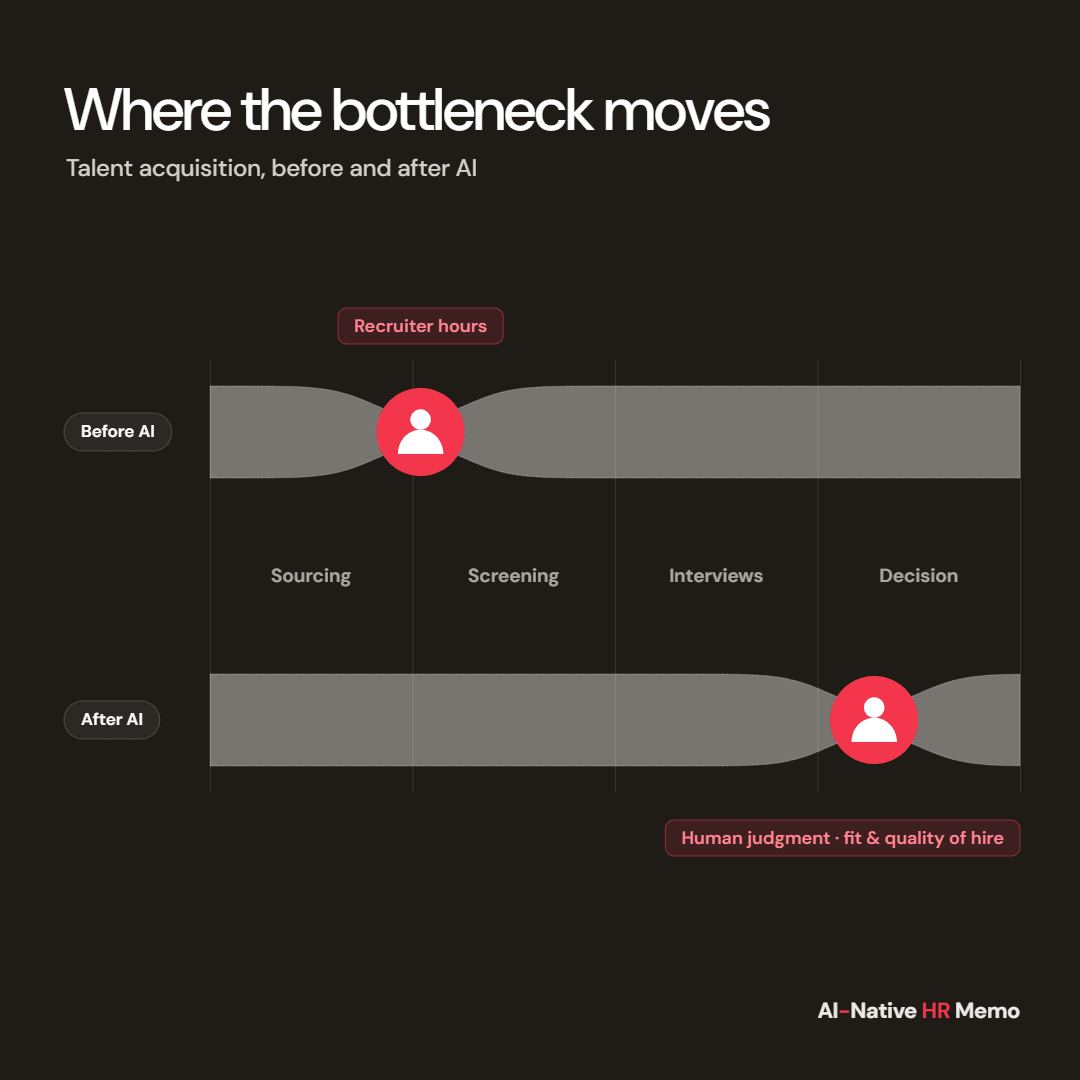
Three consequences follow, and none of them is about speed.
The first: recruiting finally gets to optimize for the number it always wanted. Time-to-fill was only ever a proxy, the metric recruiting could measure while the one that mattered (quality of hire) stayed out of reach because the loop was too long and too manual to close. When an agent sources and the loop runs one step further, a candidate is hired and then performs well three or six months in, the signal of what a strong hire looks like for that role feeds back on its own. The pipeline gets more targeted over time without anyone recalibrating it by hand.
The second: the screen stops matching keywords and starts evaluating the full applicant population against what actually predicted success in that role. That is exactly where bias gets audited out or quietly amplified at scale, depending on whether you can see how the model decided, which is why explainability stops being a compliance checkbox and becomes a design requirement.
The third is quieter and easy to miss. The same skills graph that powers external sourcing also indexes the people already inside the company, so every open role can be matched against internal candidates before it is ever posted. “Internal-first” stops being a mobility policy that everyone endorses (but almost no one follows) and becomes the default path, because the fastest and cheapest match is usually already an employee.
None of this is theory for us. We have been running recruiting at Comp with no dedicated recruiter team. Leaders do their own hunting and interviewing, and AI does the operational lifting. Everything about how we hire lives in one self-improving document the AI reads for context, from our talent philosophy to our pay policy. Assessments are binary (a 0 or a 1) with no fence-sitting; no interviewer sees another’s write-up before submitting their own; and after each round the AI drafts the assessment from the transcript for the interviewer to edit, learning from every edit. Offers generate against our salary table and anything off-standard routes to me.
Now, look at where the human sits in all of that. The operational parts that ate most of the week fall away, and the work that matters moves up rather than disappearing: to building relationships, to selling the opportunity, to the conversations that decide a hire, and to the judgment about fit. That judgment is the discipline that compounds. Every time one of us edits an AI-drafted assessment or approves a shortlist, that call either ends with that one hire or feeds back to sharpen the next recommendation, and only the second kind makes next quarter’s hiring better than this one’s.
Next in this series, the same lens on performance and development.
Once again, let us know what you thought of this piece. The newsletter compounds when you do.
Hope you enjoy what follows,
Chris Gerlach · Co-Founder & CEO, Comp
Spotlight
Gonzalo Parejo · Founder & CEO, Kamino
Fintech · Série A · São Paulo
Quando uma área da Kamino bate num limite de crescimento, o primeiro movimento do Gonzalo é olhar como aquele time está usando AI e o que está travando o output. Contratar vem só depois.
“Prior to AI, racing around and being able to hire a lot of people was a great signal. Now things have completely changed. (...) If that area is having strong constraints in terms of growth, we don't think the first option to hire more people. We think about how that team is actually using AI and how can we help that area be more productive.”
Gonzalo Parejo · Founder & CEO, Kamino
Workforce planning, leveling e a forma de ler o output de um time foram construídos sobre headcount, mas precisam ser repensados uma vez que a régua passa a ser a capacidade de execução.
Leituras
O que vale ler antes da próxima edição
Ramp + Revelio Labs · Paper · 30/Jun
A New Look at AI's Impact on Jobs
A Ramp cruzou o gasto real com AI de 21 mil empresas americanas com dados de quadro de colaboradores em um dos primeiros estudos do tipo. O título fácil seria “AI cria emprego”: adotantes crescem ~10% de headcount e o entry-level sobe até ~12%. O que importa está na divisão por intensidade: o ganho aparece só nos adotantes de alta intensidade, com investimento sustentado e material. As companhias que ficaram em assinatura de chat e pilotos de projetos não observaram mudança relevante (o paper deixa claro que “enterprise chat subscriptions do not appear to be enough”). O que compõe resultado é a profundidade operacional e o redesenho de fluxos a partir de primeiros princípios. Os autores ainda admitem que não sabem especificamente quais práticas mais impactam negócio (e, por extensão, headcount), porque quem descobriu não tem incentivos pra contar.
PwC · Relatório · Jun
Two futures for jobs in an AI era
O Global AI Jobs Barometer da PwC chega a um diagnóstico similar, mas por outro caminho: as empresas mais expostas à AI contrataram mais e pagaram mais, com prêmio salarial em torno de 62% nas habilidades de AI e um efeito “superstar” forte (os 20% do topo com +163% de produtividade). As vagas juniores mais expostas passaram a exigir julgamento e liderança, antes reservados a sêniores. Cruzado com o paper da Ramp acima, que mostra o headcount de entry-level subindo nos adotantes intensos, é possível construir o seguinte retrato: o cargo de entrada continua existindo, agora com uma régua de julgamento mais alta desde o primeiro dia. Pra quem recruta, muda o perfil que se procura, o onboarding e o leveling.
Demo
Recrutamento ponta a ponta, humano só nas decisões
 Assistir · vídeo
Na nossa leitura, recrutamento é uma das instâncias onde o salto pro N4 fica mais nítido: dá pra rodar o processo inteiro, da abertura da vaga à carta-oferta, com quase zero trabalho operacional.
No vídeo, o Pedro Bobrow (co-founder e CHRO da Comp) mostra a camada agêntica abrindo a vaga a partir do pedido do gestor, fazendo o screening com um modelo montado pra aquela empresa (a ponto de recomendar a candidata pra uma cadeira diferente da que ela aplicou), agendando as entrevistas e montando a oferta a partir da política de remuneração. O humano entra só nas decisões, como juiz, e cada uma delas vira contexto pra próxima, deixando as recomendações melhores com o tempo.
Alguns dos RHs parceiros da Comp já rodam o recrutamento nesse nível.
Featured
Da Comp: pra estar na sala (e pra rever depois)
Eventos ao vivo e materiais pra revisitar.
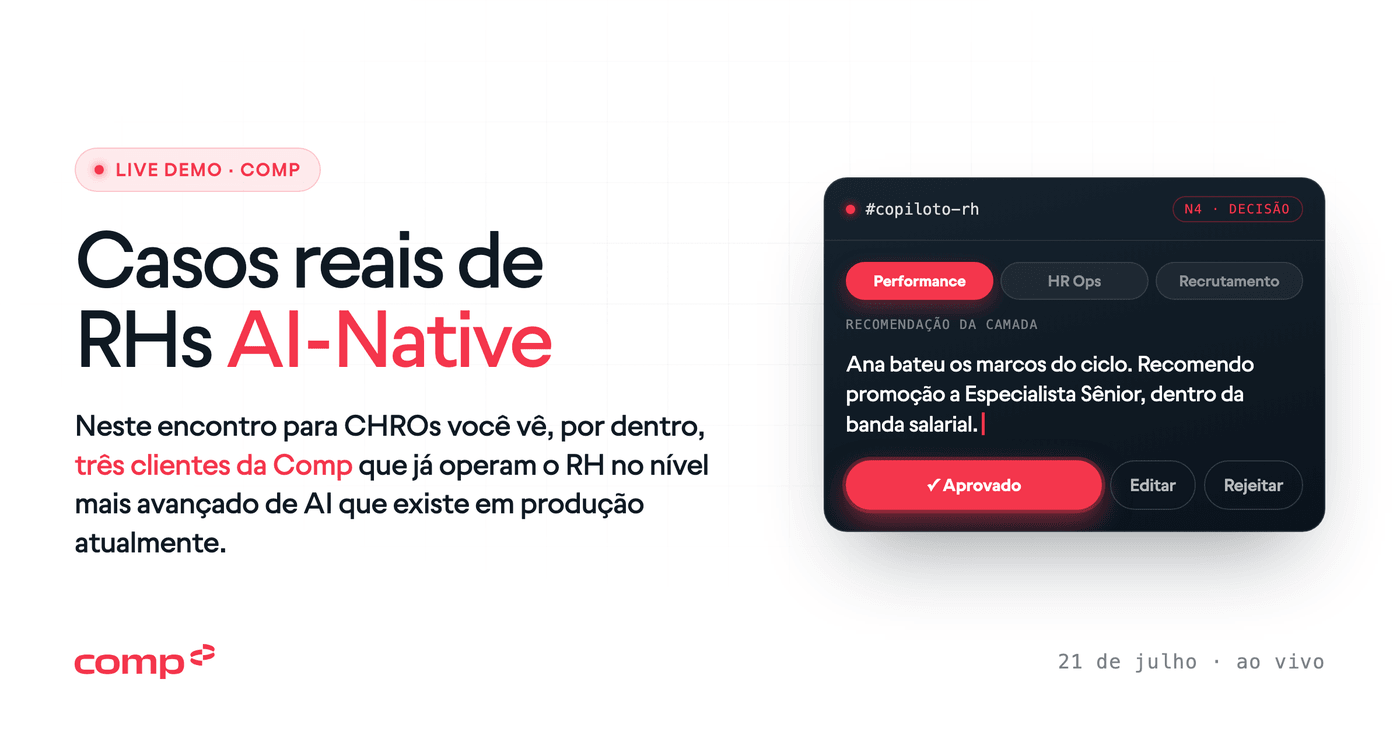
Casos reais de RHs AI-Native (live demo)
Live demo com Pedro Bobrow (Co-founder & CHRO da Comp) percorrendo três operações de RH rodando AI-Native em nível N4 (decision intelligence): uma indústria tradicional (~1.000 pessoas) com performance contínua guiada por recomendações de AI; uma enterprise (5.000+) com operações de RH sob aprovação humana; e uma scale-up de tech (500+) com o funil de recrutamento ponta a ponta. Ao vivo, com Q&A. Gravação liberada para quem se inscrever.
Garantir minha vaga →Jantar fechado · Comp House
CHROs in AI Dinner · com Gleycia Leite (Natura)
Mais uma edição do CHROs in AI Dinner na Comp House, com Gleycia Leite (Diretora de RH da Natura) e Filipe Ducas conduzindo. O fio da conversa: a transformação de AI no RH começa pela própria liderança ganhando intimidade com a tecnologia, com o RH no protagonismo.
Evento · Campinas
Humanship Experience · painel “Cultura em transformação”
A Comp no palco da 2ª Humanship Experience (150+ CHROs e líderes de RH). Painel “Cultura em transformação: decisões, práticas e caminhos do RH hoje”, moderado por Guilherme Tomazin (Revenue Owner, Comp), com Andrea Milan (CHRO, Banco BMG), Marcela Ziliotto (CHRO, Pipo Saúde) e Wellington Silverio (HR Director LATAM, John Deere).
That's issue two.
If it earned your time, forward it to one person who should be reading along.

Continue na Memo
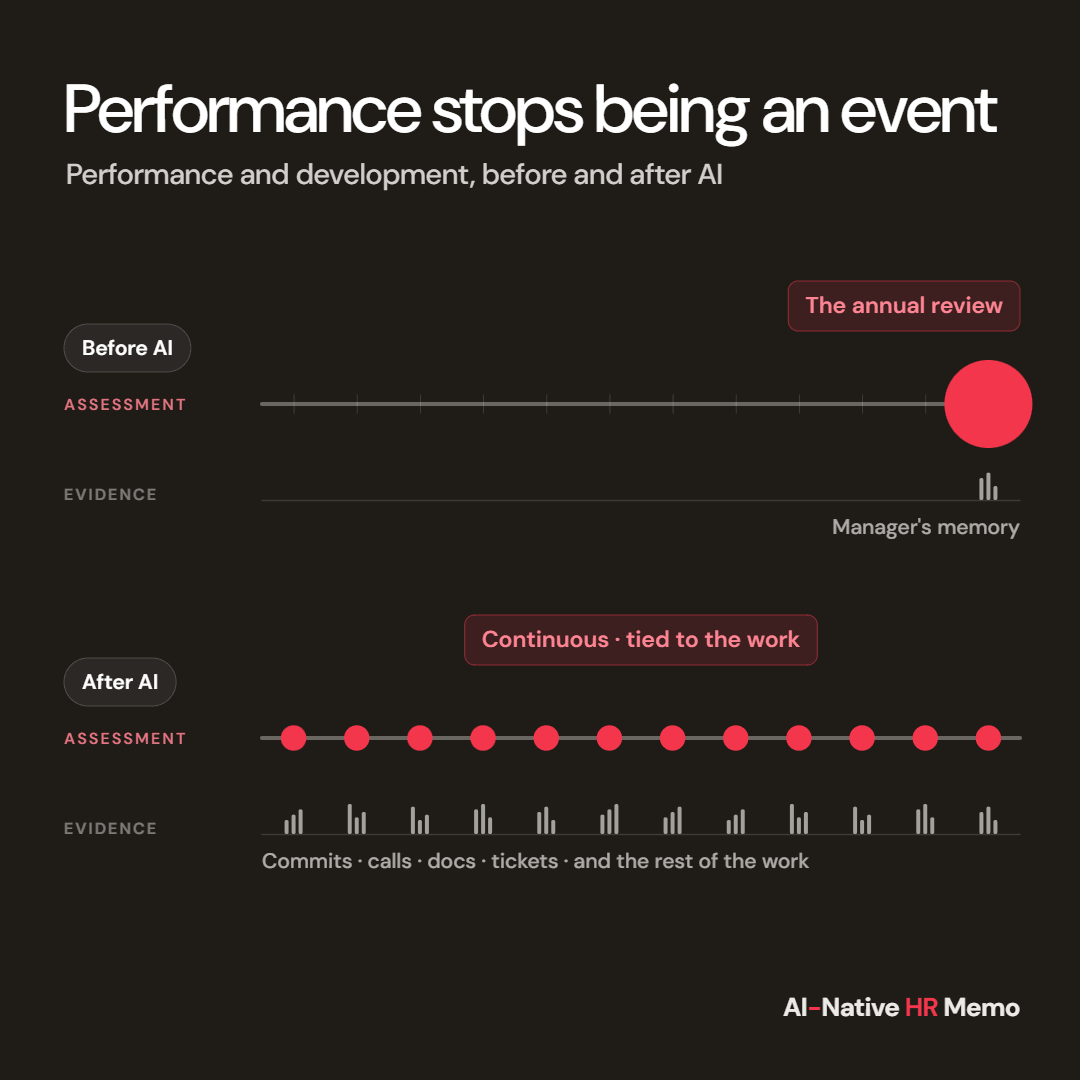
Edição 03 · 28 de julho de 2026
A performance review shouldn't be an annual event
Quando a AI lê o trabalho de verdade, a performance deixa de ser um evento anual e vira parte do trabalho. A tese aplicada a performance e desenvolvimento.
Ler edição
Edição 01 · 22 de junho de 2026
AI changes what HR is made of
Quando a inteligência fica barata e contínua, quatro constraints que definiram o RH por décadas se dissolvem. A tese que abre a Memo.
Ler edição